Can China’s Rare Earth Weapon Reshape Global Supply Chains? Strategies Investors Should Watch
Today, I’d like to discuss a topic often described as the “Achilles’ heel” of the global economy.
It’s China’s dominance over rare earth elements and the resulting transformation of global supply chains. Although the rare earth issue appears calm for now, there is a strong possibility that it will resurface in the near future.
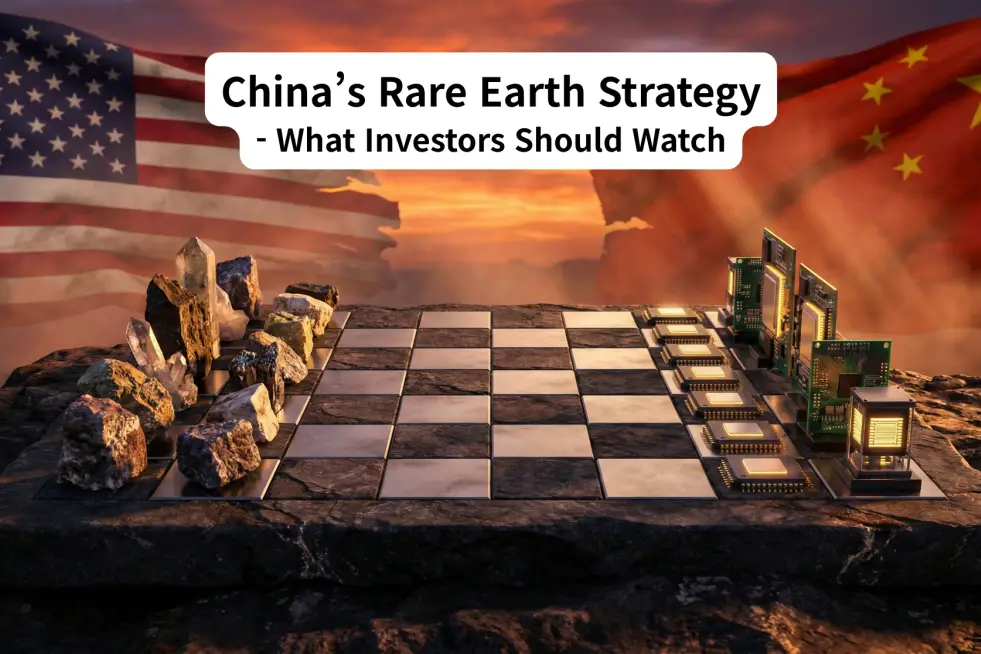
Today, we’ll take a closer look at what the rare earth issue
At the heart of the U.S.-China rivalry means for investors.
The smartphone in your hand, the electric vehicle you see on the road, and even the fiber-optic cables that support high-speed internet all share one thing in common: they rely on a critical resource known as Rare Earth Elements (REEs).
At the October 2025 Busan APEC meeting, Donald Trump and Xi Jinping agreed to suspend rare earth export controls for one year. Markets welcomed the decision, but many experts called it a “temporary peace built on sand.”
Why does China seek to weaponize this seemingly small group of minerals? And what opportunities can investors find within this structural shift? Let’s explore together.
✅ China’s Rare Earth Monopoly: More Than Just Resource Ownership
China accounts for about 80% of global rare earth production and controls over 90% of the refining process.
Despite the name, rare earth elements are not actually rare. The real challenge lies in the complex separation process, which causes severe environmental pollution. While developed countries hesitated, China steadily built infrastructure and technology, securing near-total dominance.
⚡ Key Point: China’s true strength lies not only in mining but in vertical integration turning raw ore into high-performance magnets and industrial components.
✅ Major Industries Dependent on Rare Earth Elements
Modern civilization would struggle to function without rare earths.
| Sector | Primary Use | Notes |
| Electric Vehicles | Neodymium magnets | Require 6× more minerals than ICE vehicles |
| Renewable Energy | Wind turbine generators | Require 9× more minerals than gas plants |
| Communications | Fiber-optic amplifiers | Essential for data efficiency |
| Defense | Missiles, jet engines | High strategic value |
✅ China’s Strategy: Control Through Export Licensing
Since 2023, China has operated a strict export licensing system for rare earth products.
Licenses must be renewed every six months, allowing authorities to track buyers and final usage in detail.
This goes beyond trade it enables China to monitor the global supply chain with remarkable precision.
⚡ Investor Insight: China views rare earth elements as its “secret weapon.”
This means they can serve as a powerful tool to counter technologically advanced rivals. As a result, related stock prices tend to fluctuate sharply whenever geopolitical risks intensify.

✅ Historical Lesson: Japan in 2010 and the West’s Counterattack
In 2010, during a territorial dispute with Japan, China abruptly suspended rare earth exports. Japan’s manufacturing sector suffered an immediate shock, but the incident became a turning point that triggered global efforts to reduce dependence on China.
- Technological Innovation
BMW and Renault began developing electric motors that do not rely on rare earth magnets. - Supply Chain Diversification
Japan’s dependence on China has fallen from around 90% to roughly 60% today. - Resource Recycling
Recycling facilities extracting rare earths from discarded electronics are being established in France, Canada, and other regions.
✅ U.S. Response and the Revival of Mountain Pass
The United States has also accelerated efforts toward self-sufficiency by reopening the Mountain Pass mine in California.
The U.S. government has directly supported MP Materials, while major corporations such as Apple have pledged to prioritize the use of U.S.-made rare earth magnets.

However, shortages of skilled engineers and strict environmental regulations mean that surpassing China’s capabilities will likely take considerable time.
Insight
⚡ Actionable Recommendations for Investors
China’s rare earth dominance increases short-term market volatility, but it also accelerates the global transition toward reliable supply chains outside China. Investors may consider the following strategies:
- Prioritize supply stability over pure efficiency
Companies that have secured independent or diversified supply chains are likely to outperform those focused solely on cost reduction. - Watch alternative technology sectors
Startups developing high-performance motors without rare earths or creating next-generation synthetic magnetic materials could become future leaders. - Look at the recycling industry
Businesses building circular resource systems will gain competitiveness not only from an ESG perspective but also in terms of strategic resource security.
The 2025 agreement between Trump and Xi Jinping merely bought a year of breathing room.
How quickly global companies restructure their supply chains during this grace period will shape economic leadership for the next decade. Investors should not overlook this historic shift.
This has been Michael from WStorybook. Thanks for reading!