Is the Market Always Wrong? How George Soros Broke the Bank of England
Hello! I’m Michael from WStorybook.
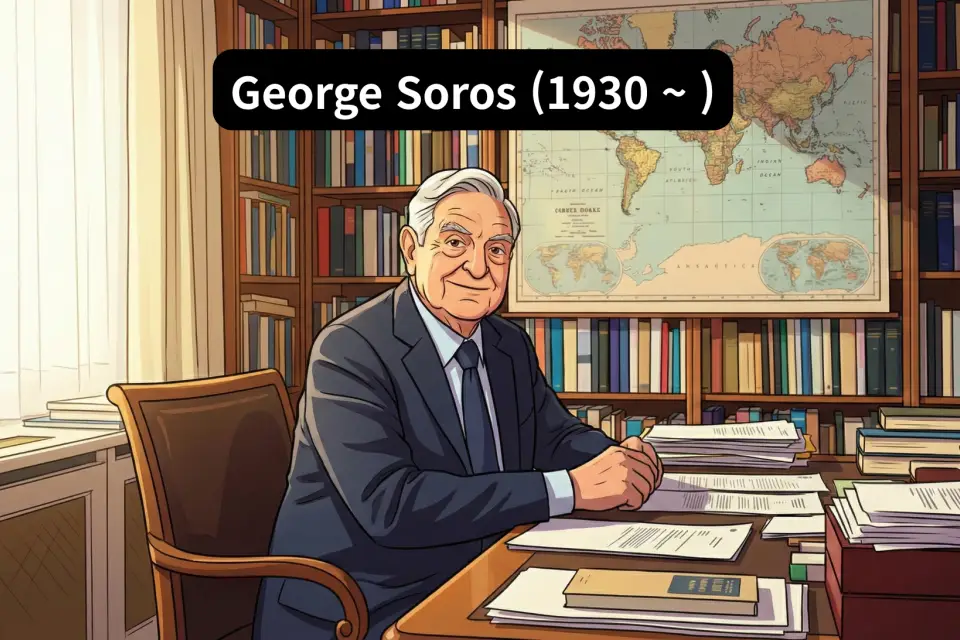
Today, I want to explore the journey of George Soros – the legendary investor famously known as “The Man Who Broke the Bank of England.”
Soros didn’t just play the market; he challenged the very foundations of traditional economics by declaring: “The market is always wrong.”
✔ “The market is always wrong.” – George Soros
“The market is always wrong. But when that error is reflected in prices, enormous opportunities arise.”
This single statement encapsulates the core philosophy of a man who, at 95 years old in 2026, remains a titan of global finance, philanthropy, and philosophy.
Today, we dive into how a boy who survived Nazi-occupied Hungary rose to the center of global markets through the power of ‘Reflexivity.’
✔ A Philosophy of Survival: Lessons from the Brink
Soros’s instinctive market acumen wasn’t born in a classroom; it was forged in 1944.
At age 14, Soros faced the Nazi occupation of Hungary. His father chose not to follow the crowd, instead securing fake IDs and scattering the family to hide.
⚡ This experience taught Soros two vital lessons
- The Reality of Uncertainty
: The world can collapse at any moment; there is no such thing as an absolute safe haven. - The Danger of Crowd Psychology
: The path taken by the majority is often the most dangerous. Survival sometimes requires defying the consensus.
Later, at the London School of Economics (LSE), Soros met his mentor, philosopher Karl Popper, whose ideas would eventually transform the world of finance.
✔ Theory of Reflexivity: Investment as Philosophy
Soros often calls himself a “failed philosopher,” yet his greatest financial successes came from applying Popper’s ideas to the stock market.
Popper’s idea that “humans are always capable of error” gave birth to Soros’s core concept
: the Theory of Reflexivity.
💡 What is the Theory of Reflexivity?
Conventional economics asserts that markets are efficient and all information is immediately reflected in prices. Soros, however, took the opposite view.
- Cognitive Bias
: Investors do not view the world objectively but through their own biased perspectives. - Market Distortion
: Investors’ misperceptions distort actual market prices. - Feedback Loop
: Distorted prices then influence investors’ perceptions again, creating bubbles or triggering crashes.
⚡ Soros understood that markets are not a process of finding the ‘correct answer,’ but rather a ‘process of repeated error and feedback.’ He targeted moments when this distortion reached its peak and hit a critical point.
✔ The Historic Achievements of the Quantum Fund That Shook the World
In 1973, Soros founded the Soros Fund (now the Quantum Fund) with his partner, Jim Rogers.
The fund’s name was derived from Heisenberg’s ‘Quantum Uncertainty Principle,’ reflecting his determination to turn market uncertainty into opportunity. The fund’s name perfectly reflects his philosophy.
[Quantum Fund Returns]
| Period | Quantum Fund Return | S&P 500 Return |
| 1970 ~ 1980 (10 years) | 3,365% | 47% |
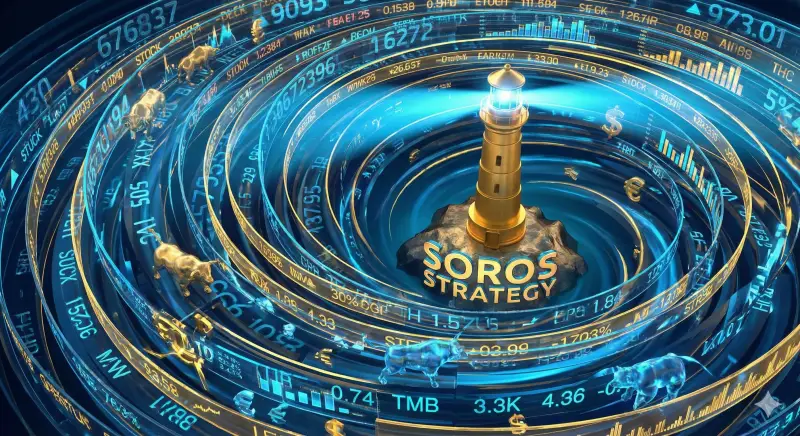
The Quantum Fund’s astonishing returns weren’t achieved through a simple buy-and-hold strategy.
Soros was a pioneer of the ‘global macro’ strategy, reading macroeconomic trends and leveraging massive amounts of capital.
✔ Historic Battles: The Bank of England and the Asian Financial Crisis
The decisive events that made Soros a legend were bold bets exploiting vulnerabilities in national systems.
1. Black Wednesday, 1992
At the time, the UK was attempting to artificially prop up the value of its currency, the pound sterling. Soros saw that the UK economy lacked the strength to sustain the pound.
- Strategy: Execution of a $10 billion short sale of the pound.
- Result: British government surrendered, pound value plummeted.
- Profit: Achieved over $1 billion in profit in a single day*
*Note: Forbes – George Soros Profile
2. 1997 Asian Financial Crisis
Having identified the contradictions in Thailand’s fixed exchange rate system for the baht, Soros launched another massive attack. This spread like dominoes, becoming the catalyst for the IMF foreign exchange crises in Southeast Asia and South Korea.
When national policy and market fundamentals diverge, the market inevitably explodes to correct that gap.
✔ Failure and Change: Lessons from the Dot-Com Bubble
There were no eternal winners. During the 2000 dot-com bubble, Soros himself took a direct hit from the tech stock crash, recording a $5 billion loss. He acknowledged his errors and made sweeping revisions to his fund strategy.
He subsequently reduced high-risk derivative investments, shifted to conservative asset management, and officially retired as a fund manager in 2011.
This exemplifies his flexibility, demonstrating that
“the speed at which one admits mistakes determines investment success or failure.”
It also showcases George Soros’s magnanimity. Ordinary people often struggle to admit they are wrong and stubbornly persist until the end.
✔ From Investor to Philanthropist, Dreaming of an ‘Open Society’
Soros is now more dedicated to social activism through the “Open Society Foundations” than to investment activities.
- Donation Scale
: Over $32 billion (approximately 42 trillion won) donated throughout his lifetime. - Areas of Activity
: Promoting democracy worldwide, protecting human rights, supporting education.
He places greater value on using his wealth to create the ‘open society’ his mentor Karl Popper advocated one where criticism and debate are possible than on the accumulation of wealth itself.

In Conclusion
George Soros’ life teaches us lessons far beyond simple investment techniques.
- Admit your mistakes
: The sooner you admit you were wrong, the smaller the loss and the closer the opportunity. - Spot market distortions
: When everyone is looking in one direction, constantly question how far that direction diverges from reality. - Invest with a philosophy
: Investing without clear principles and philosophy is mere gambling.
⚡ Actionable Suggestion for Readers
We encourage you to apply George Soros’ theory of recursion to review your current portfolio.
- What if the market is distorted, with the value of certain assets significantly inflated?
- Are investors entering the market now only seeing AI’s optimistic future in one direction?
- How can I generate greater returns when cracks appear in the market?
“The market is always wrong, and within that wrongness lies opportunity”