From Harvard Professor at 28 to U.S. Treasury Secretary: Larry Summers’ Economic Philosophy
Hello! I’m Michael from WStorybook.
Although it happened five or six years ago, one event remains vividly etched in our memories – the COVID-19 pandemic that brought the entire world to a standstill.
In early 2020, governments around the globe unleashed unprecedented fiscal policies. Financial markets crashed as if the end of the world had arrived, prompting the Federal Reserve and major economies to embark on an extraordinary spree of “money printing.”
By 2021, massive inflation began to surface. Yet most experts, including then–Fed Chair Jerome Powell, reassured the public that “inflation is merely transitory.”
Amid this widespread optimism, one figure stood almost alone, issuing a stark warning: “Unprecedented inflation is coming.”
That person was Lawrence Summers, the crown prince of economics and a fearless critic.
Today, we revisit his remarkable story: how his brilliant mind interpreted economic currents, how he overcame personal trials such as cancer, and how he rose to be called the “Economic President.”
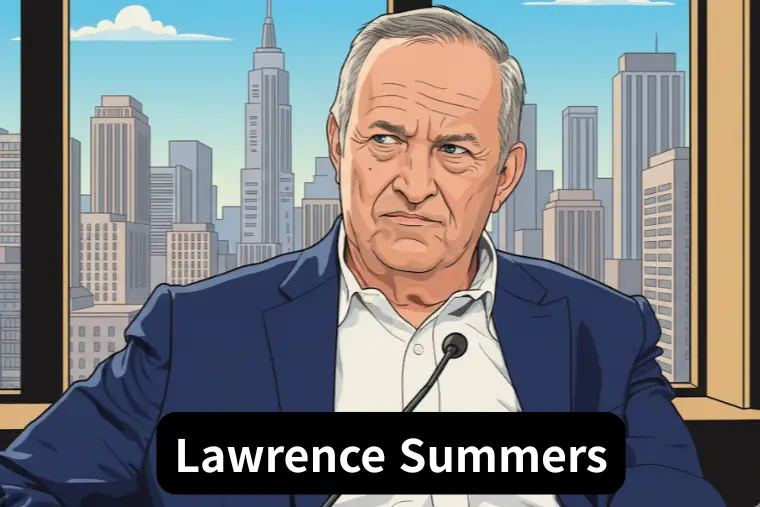
1. A Child Prodigy Born into Economics’ Royal Family
Larry Summers was born on November 30, 1954, in New Haven, Connecticut. His background was truly the “royal lineage of economics.” Both of his parents were economics professors, his uncle was Nobel Prize–winning economist Paul Samuelson, and his maternal uncle was Kenneth Arrow, another Nobel laureate.
Growing up surrounded by high-level economic discussions at the dinner table, he naturally developed an instinct for numbers and analysis. Admitted to MIT at just 16, he initially studied physics but soon became captivated by economics’ power to explain the world through mathematical models.
2. Harvard’s Youngest Full Professor at 28 and the Trial That Followed
His academic achievements were extraordinary. After completing graduate studies at Harvard, he became the youngest full professor in the university’s history at only 28.
But tragedy struck at the peak of his early success. In his twenties, he was diagnosed with Hodgkin’s lymphoma, a form of blood cancer. Despite a grim prognosis at the time, he endured the battle with intense focus and determination.
This ordeal taught the young genius humility and the finite nature of life.
He later reflected,
“After overcoming cancer, I felt I had nothing left to lose, which made me act even more boldly.”
3. Beyond the Ivory Tower: A Problem Solver in the Real World
After recovering his health, Summers expanded his role from theorist to practitioner. He served as Chief Economist at the World Bank in 1991 and later as U.S. Secretary of the Treasury (1999–2001) under the Clinton administration.
During the Asian financial crisis of the late 1990s, he was hailed as part of the “Committee That Saved the World,” alongside Alan Greenspan and Robert Rubin, an achievement that earned them the cover of Time magazine.
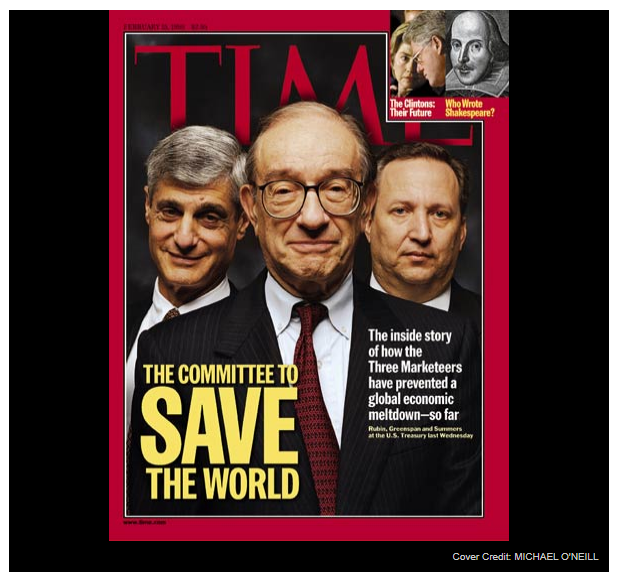
He became known as a cool-headed problem solver who, in moments of crisis, pushed forward bold liquidity injections and restructuring without hesitation.
4. 2021: Speaking the Truth When Most Were Wrong
His true value shone again in 2021. When the Fed insisted inflation would be temporary after the pandemic, Summers strongly challenged that view through media appearances and columns.
“The money being poured out now will overflow the bathtub. We will soon witness the worst inflation in 40 years.”
At the time, the Biden administration and the Fed dismissed him as overly pessimistic. But the outcome is now well known.
U.S. consumer prices surged beyond 9%, forcing the Fed to raise rates aggressively. This episode reaffirmed his reputation as one of the world’s most prescient economic forecasters.
News coverage depicting the 2021 inflation debate
5. Larry Summers’ Three Core Economic Principles
1. Beware of Secular Stagnation
He warns of a structural low-growth era in which economies struggle to recover despite low interest rates, driven by demographic decline and slowing innovation.
2. Respond to Crises with Overwhelming Force
Half measures are dangerous in emergencies. Markets must be flooded with sufficient resources to extinguish the fire decisively.
3. Trust the Truth of Data, Not Popularity
He believes economists must speak the truth revealed by data, even when it is unpopular.
“Economists who only say what sounds good cannot prevent crises.”
Insight
What are your thoughts after reading his life story?
Larry Summers is not someone who tells people what they want to hear. He speaks the uncomfortable truth – a cold, hard look at reality, even when it stings.
That is why I continue to read, analyze, and reflect on his interviews whenever they appear. His perspectives help us protect our assets and prepare for the future.
By late 2025, various controversies have made it harder to hear his voice in official settings. Yet the insights he left behind remain sharp guideposts for investors.
When markets feel uncertain, why not revisit the warnings Larry Summers once gave?