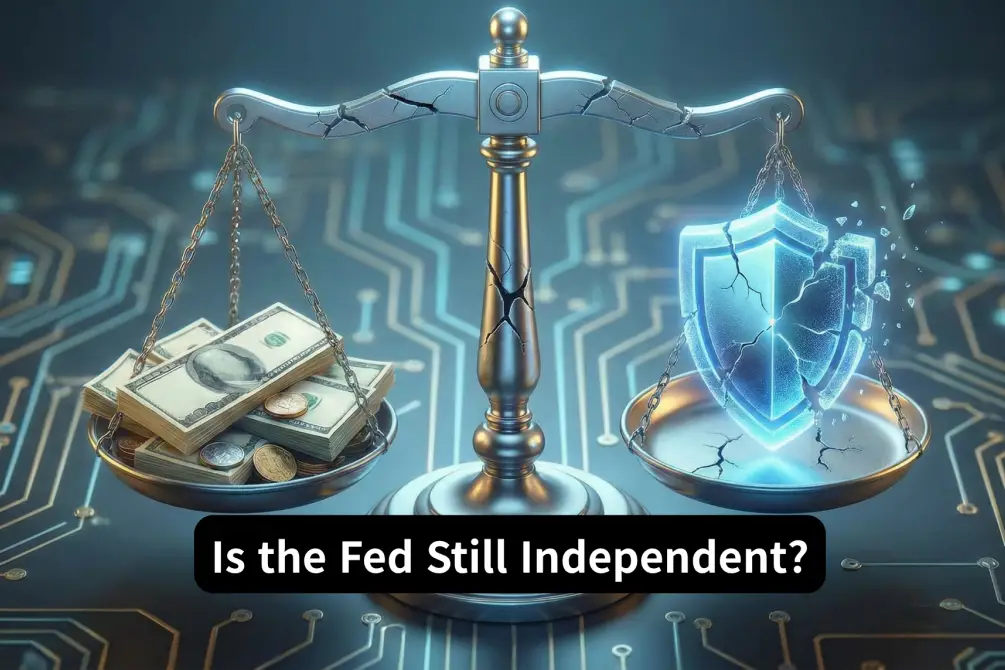
Is the Fed Still Independent? How Political Pressure Could Drive Interest Rates in 2026
On January 11, 2026, a quiet Sunday evening, the Fed made a sudden announcement.
Such announcements typically occur only during massive economic shocks, like the 2008 financial crisis or the 2020 pandemic.
But this situation was entirely different.
The crisis was triggered not by financial sector distress, but by the strategic weaponization of the legal system by the administration.

When Chairman Jerome Powell appeared on camera, tense and serious, he revealed that he had received a subpoena from the Department of Justice. Investors around the world immediately questioned:
Has central bank independence, as we have known it, come to an end?
✅ Why the Fed’s Independence Matters?
Central bank independence is a cornerstone of modern financial markets.
Politicians, seeking re-election, often favor short-term economic stimulus and are tempted to keep interest rates low. Such policies, however, risk long-term inflation.
The Fed has historically acted as a shield, protecting the value of money by making data-driven decisions free from political pressure.
✅ A History of Presidential Pressure on the Fed
Presidents have long tried to influence Fed chairmen, but the methods have evolved:
| Era | President | Method of Pressure | Outcome |
| 1965 | Lyndon B. Johnson | Summoned chairman to ranch, physically threatened him | Chairman stood firm and raised interest rates |
| 1980s | Ronald Reagan | Public criticism via Treasury Secretary | Paul Volcker curbed inflation |
| 1990s | George H.W. Bush | Blamed Fed for election loss | Political criticism only |
| 2026 | Donald Trump | Threatened criminal prosecution, issued subpoenas via Justice Department | Unprecedented weaponization of judicial power |
Unlike previous eras, this represents the direct use of the judicial system as a tool of political influence.
✅ The Pretext and the Real Goal
The Justice Department cited cost overruns from remodeling the Fed headquarters as the reason.
In reality, the goal appears to be controlling the Fed Board of Governors, which resists following the President’s policy preferences.
Targeting both Chairman Powell and Governor Lisa Cook suggests a deliberate effort to silence dissenting voices within the Fed.
✅ The ‘New Guard’ and Executive Workarounds
Officials in the White House are now exploring ways to bypass traditional institutional norms:
- Bill Pulte
– Director of the Federal Housing Finance Agency (FHFA), with connections to retail investor communities. While some reports mention symbolic tactics to influence the President, these remain unverified. - Janine Pirro
– Appointed District Attorney for Washington, D.C., leading the judicial pressure against the Fed.
Unable to directly control the Fed, they are attempting ‘Executive Quantitative Easing (QE)’.
By instructing Fannie Mae and Freddie Mac to purchase $200 billion in mortgage-backed securities (MBS), they aim to artificially lower market interest rates without Fed approval.
*Note: FHFA’s $200 billion MBS purchase
INSIGHT
📌The real implications of this situation for investors
This situation transcends internal U.S. political conflict; it represents a test of the rule of law and institutional independence, the very foundations of trust in global capital markets.
As investors, we must prepare for the following changes:
- Rising Risk Premiums
U.S. Treasuries have been a ‘safe asset’ because of the Fed’s reliability. If the Fed becomes politically influenced, investors will demand higher interest rates to compensate for uncertainty.
⚡ Paradoxically, market rates could rise even as the government tries to lower them. - Risk of Stagflation
Tariff policies, currency depreciation, and artificially low interest rates increase the risk of stagflation – high inflation paired with low growth. - Diversification of Asset Allocation
: Leading asset managers like PIMCO are moving away from U.S. assets and diversifying globally. Investors should reconsider the assumption that U.S. markets are absolutely safe.
📌 Actionable Recommendations
- Track long-term Treasury yields rather than short-term Fed-driven rates.
- Increase exposure to inflation-hedging assets such as gold and commodities.
- In times of heightened political uncertainty, prioritize cash flow and conservative investment strategies.
A central bank that loses its independence cannot safeguard the value of money. In these turbulent times, protecting your assets requires vigilance and insight.
This is Michael from WStorybook. Thank you for reading.