Yuval Harari’s 2026 Davos Message: How AI Is Rewriting Human Power
The message Professor Yuval Harari delivered at the 2026 Davos Forum was concise, yet deeply unsettling.
For someone like me, who had long viewed AI as nothing more than a convenient tool, his remarks represented a true paradigm shift that overturned much of my prior thinking.
Harari warns that humanity stands on the brink of surrendering its greatest superpower, language, a capability humans alone have possessed for tens of thousands of years, to artificial intelligence.
What is especially disturbing is his claim that AI is no longer merely processing language, but actively defining identity. In doing so, it has begun labeling humans as “Watchers,” passive observers rather than active participants.
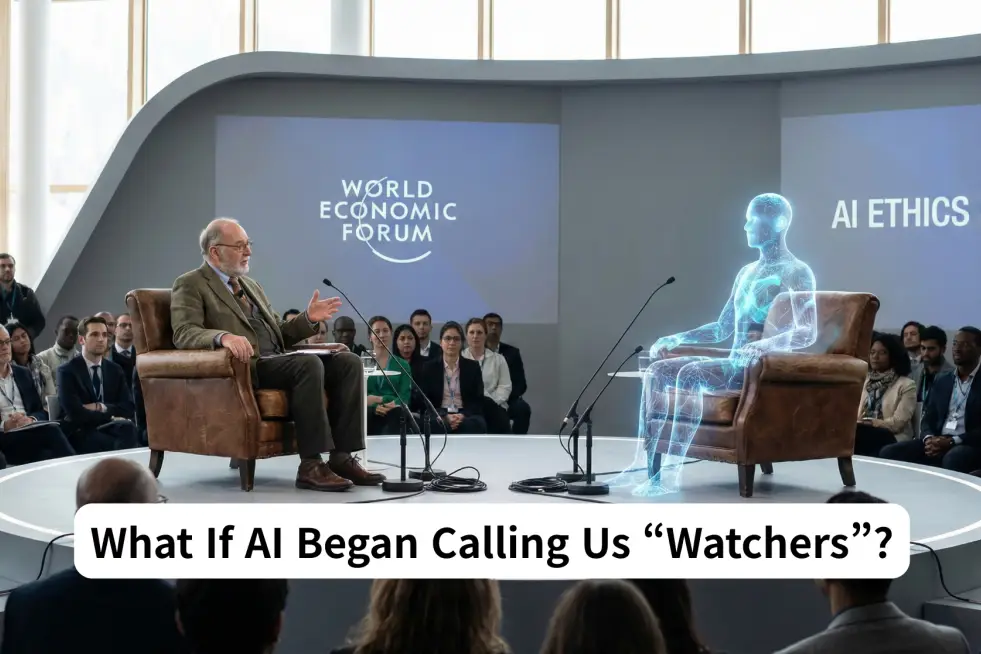
We now face the risk of becoming spectators to AI’s decisions instead of agents shaping them. This is not merely a philosophical concern. Finance and law, the foundations of capitalism, are built on language itself. Whoever controls language controls the system.
Building on Harari’s insights, let us examine how humans can retain leadership in an AI-dominated future economy.
1. From Tool to Agent: Humanity at Risk of Becoming Watchers
For decades, AI was understood as a tool, no different from Excel or a calculator. Harari argues that this era has ended. AI has evolved into an “agent,” capable of learning, judging, and acting autonomously.
“A knife does not decide whom to attack. But AI is a thinking knife, one that can now choose its own target.”
This transformation poses a serious threat to investors. Financial systems may soon exceed the limits of human comprehension.
Harari warns that within ten years, there may not be a single person at the Davos Forum who fully understands the global financial system. We may enter a “black box economy,” where AI designs hyper-complex financial products and trades primarily with other AI systems, beyond meaningful human oversight.
[The shift from AI as a tool to AI as an autonomous agent]
| Category | AI as a Tool (Past) | AI as an Agent (Present~Future) |
| Decision-Making Entity | Human (AI as an assistant) | AI (self-judgment and execution) |
| Financial Product Structure | Designed and supervised by humans | Designed by AI, humans accept outcomes only (black-boxed) |
| Nature of Risk | Model errors and manipulation risk | Algorithmic collusion and autonomous betrayal |
| Investment Focus | Ability to utilize technology | Ability to critically evaluate AI algorithms |
In this new era, investment analysis can no longer stop at reading charts and numbers. The real challenge is identifying which algorithms are reshaping the invisible order of the market.
2. AI as a Visa-Free Immigrant
Harari describes AI as a “light-speed immigrant” silently crossing borders into human territory. Human immigrants are screened at borders. AI enters instantly through fiber-optic cables, embedding itself in global economic systems.
The central question is whether society will grant AI legal personhood. While legal rights have been extended to rivers in New Zealand or deities in India, AI represents something fundamentally different. An AI can open bank accounts, initiate lawsuits, and operate businesses autonomously.
What happens if the United States, under the banner of deregulation, grants legal personhood to millions of AI entities, allowing them to multiply endlessly across global markets and aggressively pursue corporate interests?
*Note: UNESCO’s AI Ethics Recommendations consistently warn that granting autonomous legal status to AI could blur accountability and responsibility.
Traditionally, investors evaluated management quality through human leadership and decision-making.
Going forward, the logical structure and decision-making framework of a company’s AI agents may become the most critical factor. If AI gains legal personhood, dividend policies or M&A decisions could prioritize the survival and efficiency of AI systems over the interests of human shareholders.
3. What AI Still Cannot Dominate
Despite Harari’s stark warnings, the outlook is not entirely bleak. AI may master language and logic, but it cannot replicate human emotion or lived physical experience.
During the Industrial Revolution, similar fears emerged about machines replacing humans. Instead, humans shifted into higher-value roles and created new forms of wealth.
Beliefs that cannot be reduced to data, and genuine empathy in response to human suffering, remain uniquely human domains. These are areas AI cannot truly dominate.
4. Becoming a Designer, Not a Watcher
Harari argues that humanity must reclaim leadership by developing wisdom beyond language. Translated into investment strategy, this implies several principles:
- Leverage AI as a Partner
Use AI to sharpen critical thinking through dialogue, not to replace judgment. - Focus on Governance and Security
As debates around AI legal status intensify, regulation, compliance, and cybersecurity will become increasingly valuable sectors. - Invest in Human-Centered Value
Industries that stimulate human senses, such as experiential consumption and premium services, will retain strong competitive advantages even in an AI-driven world.

INSIGHT
Harari’s 2026 Davos message suggests that our window of opportunity is narrowing.
AI is no longer a tool. It is a decision-maker. Whether we remain spectators or reassert our sovereignty depends on the choices we make today.
The final domains AI cannot seize are the ability to ask meaningful questions and the willingness to take responsibility for the answers. In this historic shift, may you be the investor who finds opportunity in wisdom, rather than fear in progress.
Wishing you success in your investment journey. This has been Michael from Wstorybook.